Tokyo Play 10th Anniversary Crowdfunding — English Version
2026/10/25 10:39
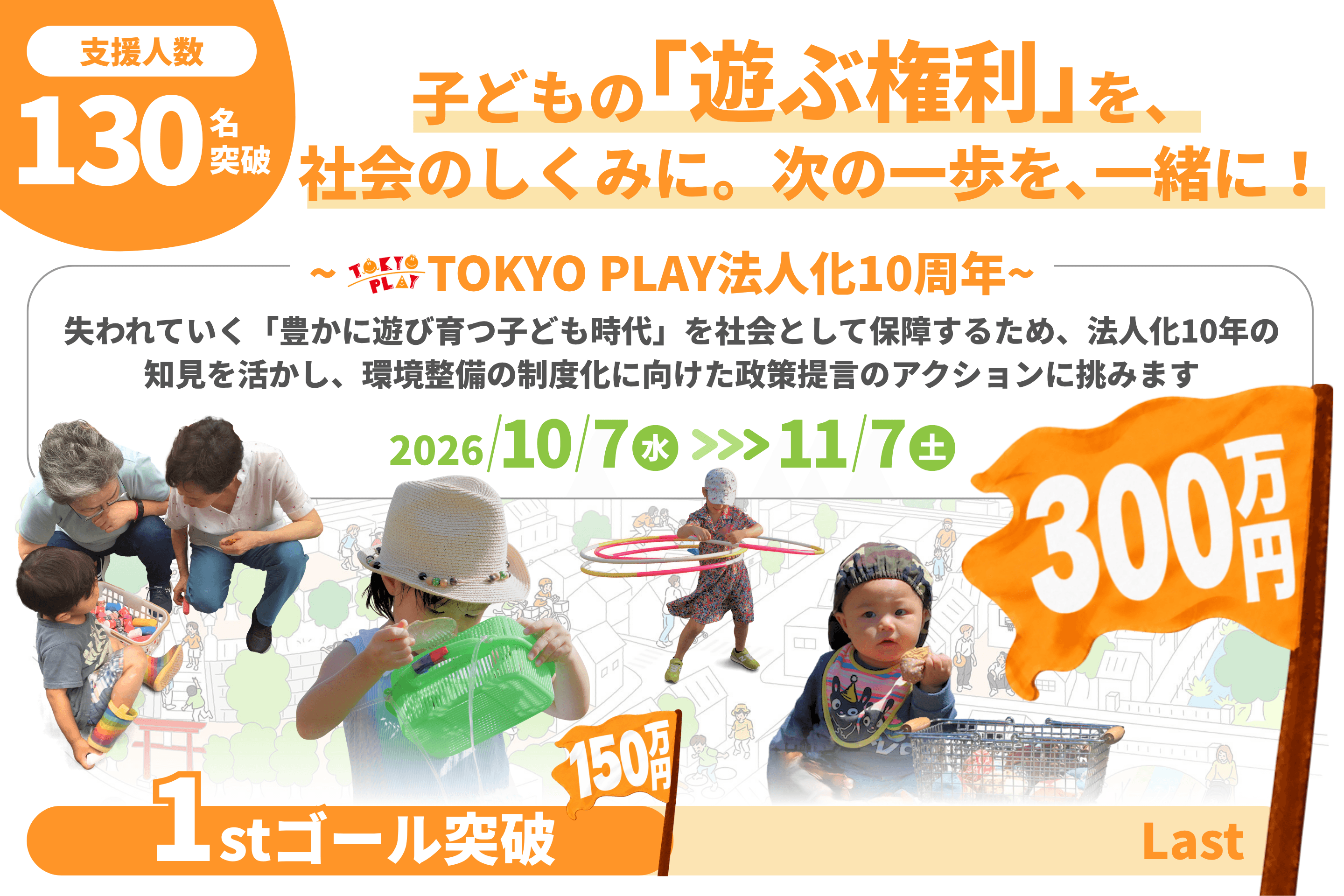
Tokyo Play – 10 Years of Listening to Children. Now We Turn Their Voices into Policy. Join Us in Advancing Children’s Right to Play
At Tokyo Play, we work to shape public policy so that every child can grow up in an environment rich in play, curiosity, and discovery. Play is not an optional activity—it is a fundamental human need and a right that must be protected.
As we mark our 10th anniversary, we are launching a donation campaign to take a major step toward the next decade. Your support will help us transform frontline insights into systemic change, ensuring that children’s right to play is recognised, valued, and embedded in public policy.
Tokyo Play 10th Anniversary – Grand Thank You Festival
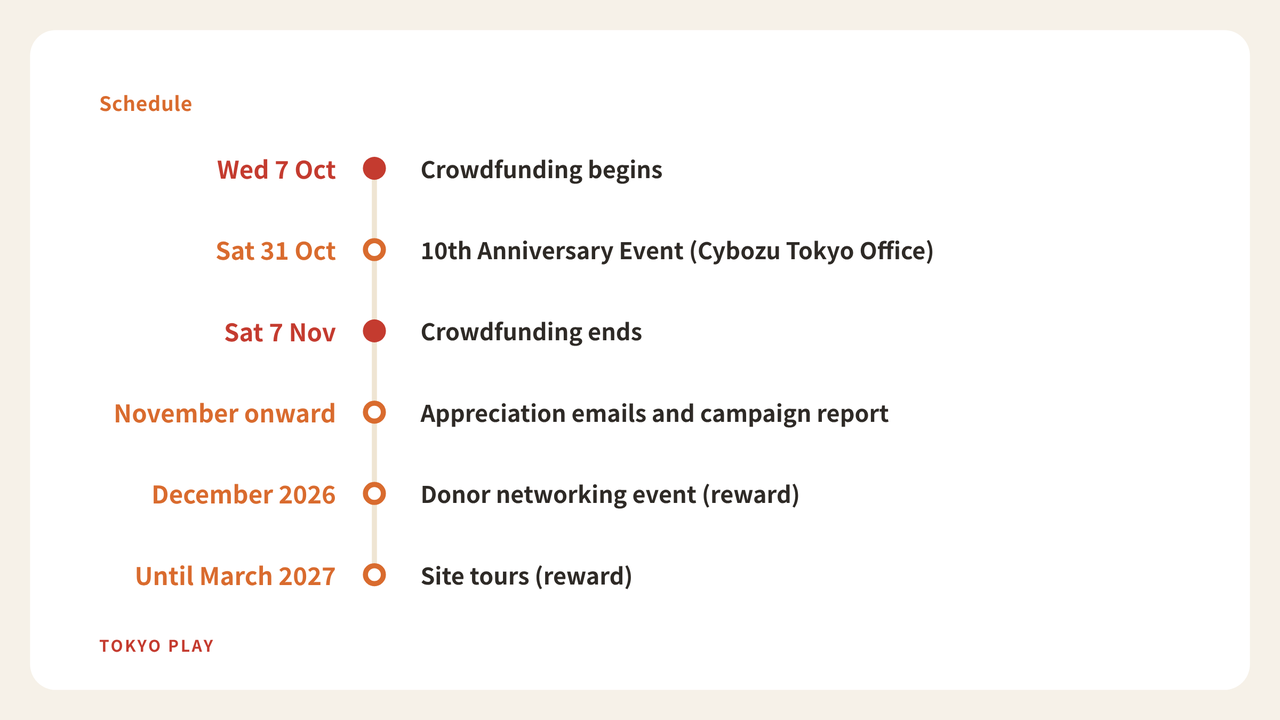
31 October, from 13:30 @ Cybozu Tokyo Office Event page: https://tp10th.peatix.com/
Donation Options
(Exchange rate as of 24 Oct 2026)
5,000 yen (approx. 32 USD / 29 EUR) – Appreciation email
10,000 yen (approx. 64 USD / 57 EUR) – Invitation to the festival and networking event – Your name listed in our annual report
30,000 yen (approx. 192 USD / 170 EUR) – Invitation to site tours – 10 printed copies of the Play Manifesto – Plus all rewards above
50,000 yen (approx. 319 USD / 285 EUR) – Consultation meeting with our managers – Plus all rewards above
100,000 yen (approx. 638 USD / 569 EUR) – Up to 30 printed copies of the Play Manifesto – Consultation meeting with the director – Plus all rewards above
150,000 yen / 200,000 yen – Invite the director for a lecture or consultation – Plus all rewards above (travel fees not included)
A Message from the Director
Hello, I’m Hitoshi Shimamura, Director of Tokyo Play.
When we founded Tokyo Play in 2010, our vision was simple yet bold: “We work to establish Tokyo where all children can play.”
Over the past decade, we have supported grassroots initiatives, made policy recommendations, delivered play training, and run campaigns—always together with citizens, local governments, industries, researchers, and practitioners.
This year marks our 10th anniversary as a registered organisation. With deep gratitude to everyone who has supported us, we are launching this crowdfunding campaign to take a new step toward the next decade—toward a society where every child can enjoy a playful life and grow up with a strong sense of self.
Why Play Matters
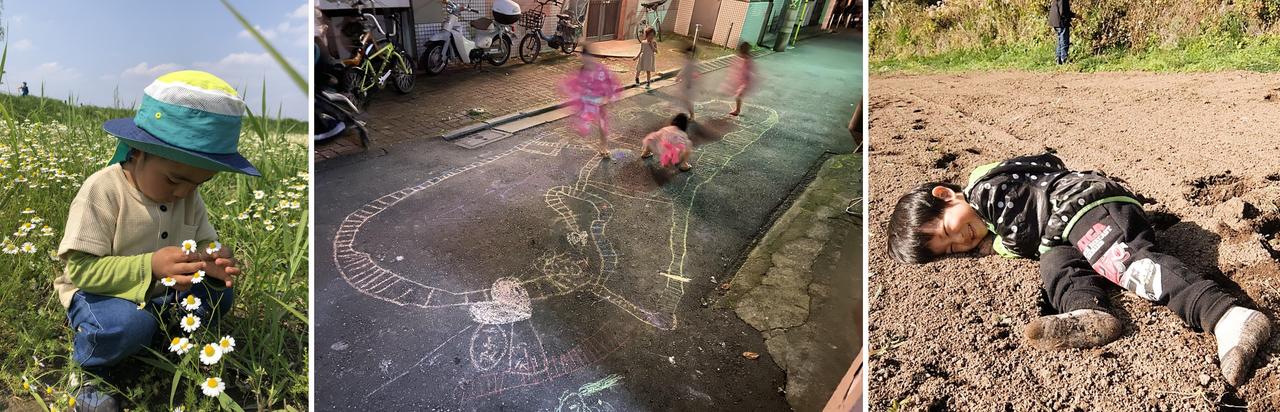
Play is a natural inner drive. It is how children explore the world, understand themselves, and build confidence—through activities they choose and control. Climbing trees, watching clouds, reading comics… anything can be play. It is the foundation of identity.
Yet children today face increasing restrictions: “It’s dangerous.” “Too noisy.” “No entry.” “You have cram school.”
Time and space for play are shrinking. Children are pushed toward structured activities or screens. Diversity in play environments is rapidly disappearing.
We want to send this message not only to those who have been involved with Tokyo Play, but also to anyone who feels this issue matters—even if they are unsure what can be done.
What Is the Child’s Right to Play?
Tokyo Play regards play as both a biological need and a fundamental right. Through repeated play experiences, children naturally develop self-determination, risk literacy, cooperation, resilience, self-esteem, and tolerance for uncertainty—skills essential for later life.
Article 31 of the UN Convention on the Rights of the Child guarantees this right to every child, regardless of financial or social circumstances.
The Shrinking Play Environment in Japan
Japan has 115,000 parks, 4,200 children’s centres, and millions of game devices sold. On the surface, it may seem children have plenty of places to play.
But reality tells a different story.
Children say things like:
“We only have 17 minutes left to play.”
“I need to leave soon for cram school.”
“I’m glad my extracurriculars were reduced from 10 to 8.”
“If a park is built there, we won’t be able to play freely anymore.”
“We used to play baseball there, but a man shouts at us now.”
“I have to study 400 hours during the 40-day summer break.”
These voices are not rare—they are common.
Some facts:
– 69.9% of primary school children play with friends once a week or less after school.
– In Tokyo’s 23 wards, around 80% of parks prohibit ball games.
– Many after-school clubs impose strict rules limiting movement.
– Upper primary students spend nearly four hours a day online.
– Indicators of children’s wellbeing worsen every year.
– In 2025, 538 children took their own lives—the highest number ever recorded.
– Reported bullying cases reached 769,000.
– 36% of primary school children have vision below 1.0—double the rate in 1979.
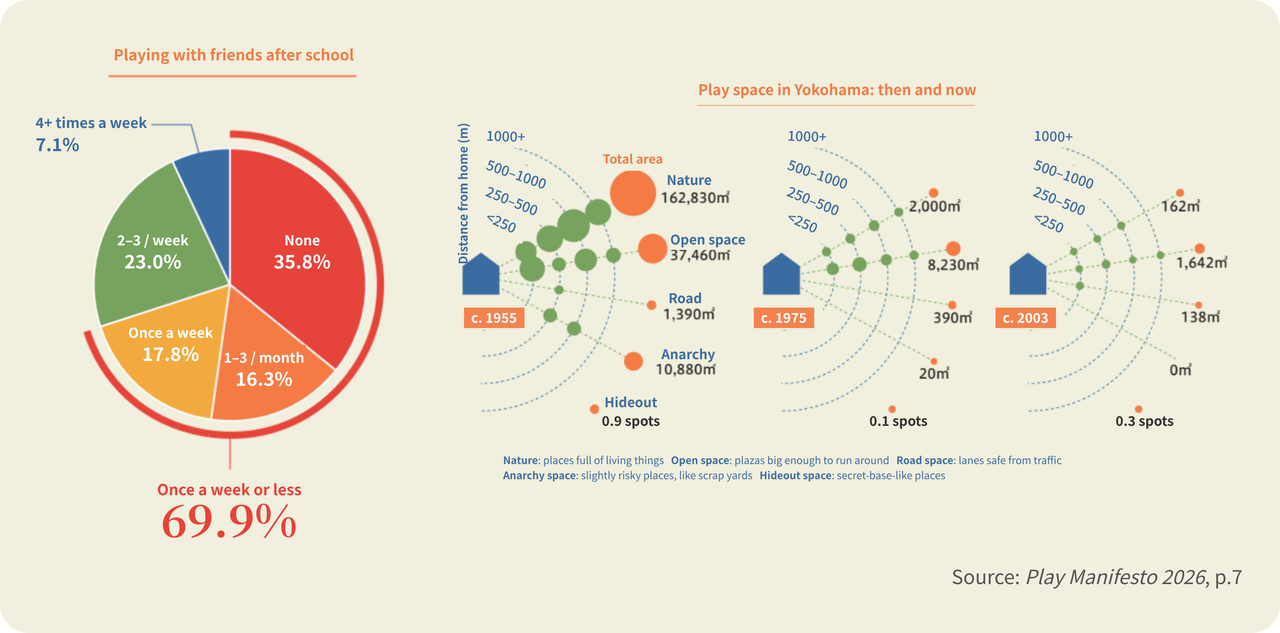
Despite all this, Japan has no system requiring national or local governments to ensure children’s right to play.
This is no longer an issue families or grassroots groups can solve alone. It is a public health challenge that must be addressed at the policy level.
Changing the System Can Change Children’s Lives
Some may say, “Times have changed; children simply play less now.” But other countries prove otherwise.
Wales, UK
- Adopted the world’s first Government Play Strategy in 2006
- Introduced legislation in 2010 requiring all local authorities to assess and improve play -environments
- Over 70% of children play outdoors almost daily – Children’s satisfaction with school break times reaches 80% – Policies extend beyond parks to education and urban planning
Taiwan
- Promotes 120 minutes of outdoor activity per day – Successfully reversed the trend of worsening eyesight among primary school children
Japan can do the same—if we act now.
What Tokyo Play Has Achieved in the Past 10 Years
Tokyo Play does not run playgrounds. Instead, we empower communities and institutions to take action, drawing on decades of practical experience.
Street Play – 201 sessions · 27,154 participants
- Short-term road closures create play spaces that connect neighbours across generations.
Adventure Playground Playworker Training – 1,200+ days
- Supporting NPOs to guarantee children’s freedom to play.
Tokyo Play Day – 754 locations
- A citywide celebration of play every year around 1 October.
Children’s Consultations – 250+ sessions · 1,300+ participants
- Listening to children and incorporating their voices into community planning.
Lectures & Training – 480+ sessions · 12,500+ participants
- Sharing the importance of play across Japan and internationally.
Policy Recommendations – Play Manifesto 2026
- A comprehensive proposal for systemic change, backed by data.
- Download: https://note.com/tokyoplay/n/n71be01dd240c
These efforts have already influenced local policies and ordinances.
The Next 10 Years: Turning Frontline Insights into Policy
Our next decade begins with a clear mission: Transform children’s play environments through systemic change.
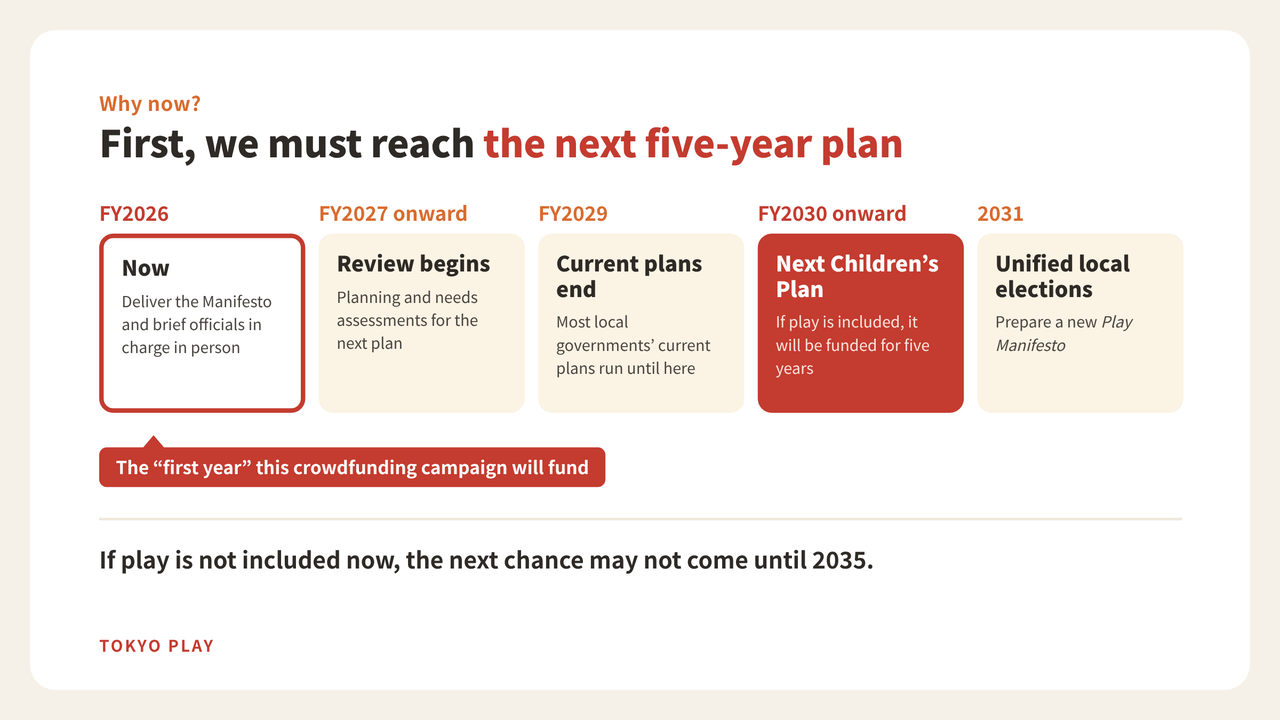
Japan’s national Children’s Policy Outline includes “creating opportunities for diverse play,” but this does not guarantee action. Local governments must include play in their Children’s Plans—otherwise, no budget or measures will follow.
The next revision cycle begins around 2027. If play is not included then, the next chance may not come until 2035.
We cannot wait.
What the Play Manifesto Proposes
- Include play in needs assessments for Children’s Plans
- Integrate the right to play into nursery and school guidelines
- Introduce national and local assessments of play environments
These steps will ensure play becomes a visible, measurable, and actionable priority.
Why We Need 3 Million Yen
Policy advocacy is not profitable. Donations are the only way to support this work.
3 million yen will fund the first year of the transition from frontline practice to policy change.
We will also launch a monthly supporter scheme to sustain this work beyond one year.
How Your Donation Will Be Used
① Operational costs for advocacy
- To begin policy work without interrupting ongoing community projects.
② Dissemination of the Play Manifesto
- Printing, design, travel, meetings, and study sessions.
③ Research and data collection
- Essential for ensuring play is included in the next Children’s Plan.
Our Vision for the Future
We aim for a society where “No Ball Games” signs are no longer the norm. Where play is recognised in legislation and local plans. Where antenatal classes, school playgrounds, public spaces, and community development all embrace the importance of play.
Imagine: On 11 June, International Day of Play, the square in front of every city hall becomes a place to celebrate children’s right to play.
If play is included in the 2030 Children’s Plan, it will be funded for five years. We will prepare a new Play Manifesto ahead of the 2031 elections. And we hope this movement, born in Tokyo, will spread across Japan.
Schedule
Rewards
Details are listed on the right side of the screen (or bottom on smartphones). If you donate after 31 October, you will not be invited to the festival, but all other rewards apply.
Other Ways to Support Us
Even simply raising awareness helps change society.
You can: – Share this campaign and the Play Manifesto – Check whether your local Children’s Plan includes play – Introduce Tokyo Play to friends interested in social issues – Invite potential supporters to our 10th Anniversary Festival
Small actions create big change.
Frequently Asked Questions
What does Tokyo Play do?
We help create communities where children can play freely. We support local initiatives, listen to children’s voices, provide training, and make policy proposals.
Do you run your own play areas?
No. We support others in creating play environments and work on systemic change.
Are donations tax-deductible?
No. As a general incorporated association, donations are not tax-deductible.
What if the target amount is not reached?
This is an all-in campaign. All funds raised will be used.
When will rewards be delivered?
– Thank-you email: November – Printed Manifesto: December – Site tours & consultations: Contact in November; tours by March 2027 – Donor networking event: December 2026 – Names in annual report: Autumn 2027
One-time or monthly donation?
Both help. One-time donations support next year’s step; monthly donations sustain long-term change.
Monthly supporters: https://tokyoplay.jp/support/#donation-monthly
+現場ツアーにご招待します ★おすすめ★
30,000円
◎2027年3月までに開催されるみちあそび等のプログラム現場ツアー(場所・日時は随時更新)に参加いただけます。
・10/31(土)感謝祭にご招待します。 ※感謝祭(10月31日)より後にご寄付いただいた場合、感謝祭へのご招待はございません。
・寄付者限定:スタッフとの交流会(12月頃)に参加いただけます。
・遊びのマニフェストの紙版(0〜10冊まで希望制)をお送りします。
・お礼メールをお送りします。
・年次報告書等への寄付者名掲載(希望者のみ)させていただきます。
+感謝祭 / 寄付者交流会にご招待します
10,000円
◎10/31(土)感謝祭にご招待します。
◎寄付者限定:スタッフとの交流会(12月頃)に参加いただけます。
・お礼メールをお送りします。
・年次報告書等への寄付者名掲載(希望者のみ)させていただきます。
※感謝祭(10月31日)より後にご寄付いただいた場合、感謝祭へのご招待はございません。
+個別相談会にてご相談をお受けします
50,000円
◎TOKYO PLAYディレクター(大野、神林、高橋、矢野より希望制)が個別相談会にてどんな内容でもまずご相談受けます!(希望者のみ)
・2027年3月までに開催されるみちあそび等のプログラム現場ツアー(場所・日時は随時更新)に参加いただけます。
・10/31(土)感謝祭にご招待します。 ※感謝祭(10月31日)より後にご寄付いただいた場合、感謝祭へのご招待はございません。
・寄付者限定:スタッフとの交流会(12月頃)に参加いただけます。
・遊びのマニフェストの紙版(0〜10冊まで希望制)をお送りします。
・お礼メールをお送りします。
・年次報告書等への寄付者名掲載(希望者のみ)させていただきます。
+代表嶋村仁志が、個別相談会にてご相談をお受けします
100,000円
◎代表嶋村が個別相談会にてどんな内容でもまずご相談受けます!(希望者のみ)
・2027年3月までに開催されるみちあそび等のプログラム現場ツアー(場所・日時は随時更新)に参加いただけます。
・10/31(土)感謝祭にご招待します。 ※感謝祭(10月31日)より後にご寄付いただいた場合、感謝祭へのご招待はございません。
・寄付者限定:スタッフとの交流会(12月頃)に参加いただけます。
・遊びのマニフェストの紙版(0〜30冊まで希望制)をお送りします。
・お礼メールをお送りします。
・年次報告書等への寄付者名掲載(希望者のみ)させていただきます。
+代表嶋村仁志が、出張でお引き受けします
150,000円
◎代表嶋村が出張でお引き受けします!(研修/講演/事業相談など)※まずは個別相談させていただき、ご要望にお応えします。(希望者のみ)
・遊びのマニフェストの紙版(0〜30冊まで希望制)をお送りします。
・お礼メールをお送りします。
・年次報告書等への寄付者名掲載(希望者のみ)させていただきます。
+代表嶋村仁志が、出張でお引き受けします
200,000円
◎代表嶋村が出張でお引き受けします!(研修/講演/事業相談など)※まずは個別相談させていただき、ご要望にお応えします。(希望者のみ)
・2027年3月までに開催されるみちあそび等のプログラム現場ツアー(場所・日時は随時更新)に参加いただけます。
・10/31(土)感謝祭にご招待します。 ※感謝祭(10月31日)より後にご寄付いただいた場合、感謝祭へのご招待はございません。
・寄付者限定:スタッフとの交流会(12月頃)に参加いただけます。
・遊びのマニフェストの紙版(0〜30冊まで希望制)をお送りします。
・お礼メールをお送りします。
・年次報告書等への寄付者名掲載(希望者のみ)させていただきます。